

Qore's Cairo OOH Launch: Is Brand-First Real Estate Advertising Becoming the New Pattern?

Qore Developments has made its Cairo OOH debut with a brand-first campaign that reveals almost nothing about a specific project. There is no development name, no unit type, no price per metre. Instead, four words sit in white against black: “Everything builds from the center.”
That restraint is the whole pitch.
Rather than introducing itself through inventory, Qore is asking Cairo to remember the brand first. The approach puts identity, mood, and positioning ahead of the usual real estate sales language, making the campaign less about what Qore is selling today and more about what the name should come to represent.
Whether that early investment in brand recognition translates into stronger demand once projects enter the picture remains an open question. For now, the campaign is focused on making Qore familiar before giving audiences anything more specific to buy into.
What Is Qore Developments Trying to Say With Its Cairo Debut?
This is a brand launch before it is a project launch.
The campaign does not name a development, identify a location, show a unit, or introduce a commercial offer. Instead, it puts Qore Developments and the line “Everything builds from the center” at the centre of the communication.
That gives the campaign a different job from the product-led advertising that dominates much of Cairo’s real estate OOH landscape. The immediate objective appears to be establishing a recognizable brand idea rather than explaining a project.
The word “center” carries much of that positioning. It can be read literally through the architectural imagery, but it also gives Qore a broader conceptual territory around foundations, focus, and what everything else is built from.
For a new name entering Cairo’s outdoor landscape, that gives the brand something to own before a project name begins competing for attention.
How Qore Uses Monochrome Creative for Its Brand Debut
The visual execution is predominantly monochrome, leaning into black, white, concrete, and hard architectural contrast.
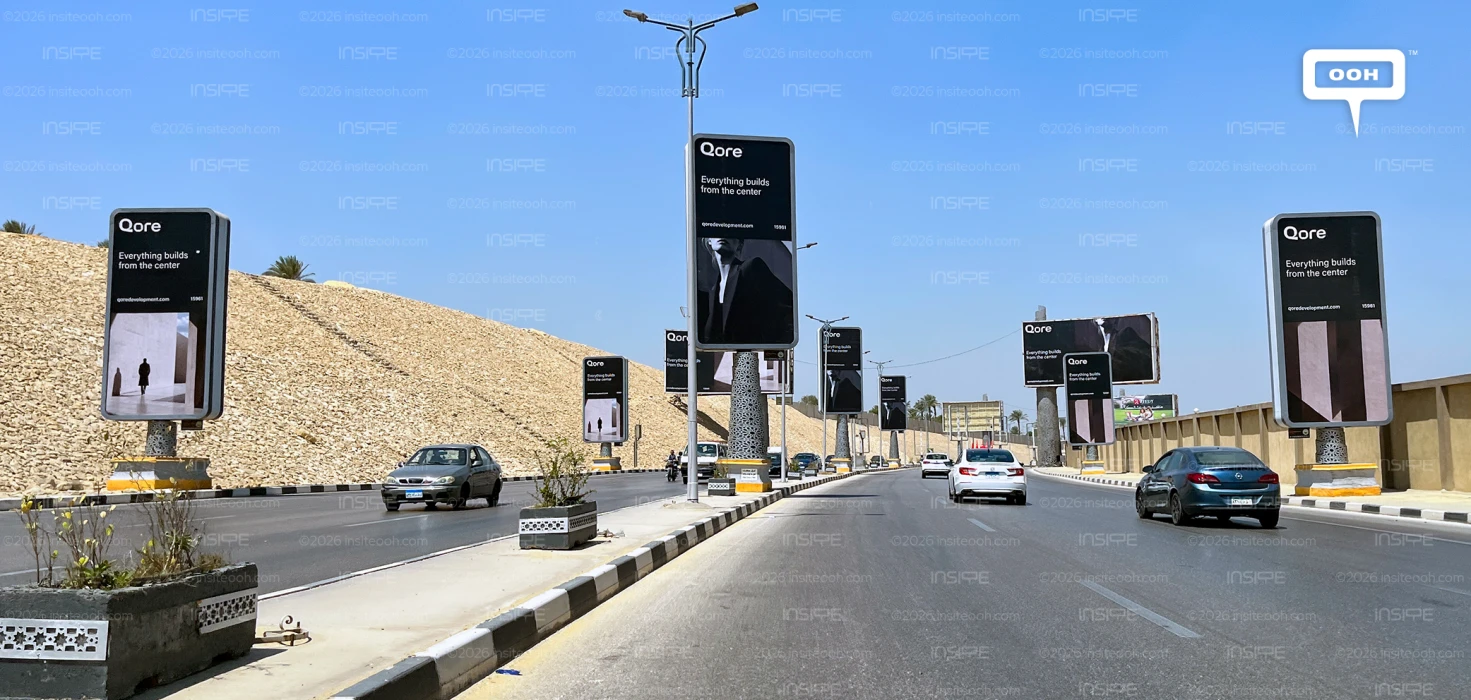
A lone figure in a dark coat walks through a corridor of stone and concrete, caught beneath a shaft of light that splits the composition between shadow and pale marble. The Qore wordmark sits in the upper-left corner, followed by the campaign line, while qoredevelopment.com and the hotline 15961 remain tucked into the lower edges of the creative.
Nothing else competes for space.
That visual restraint mirrors the campaign’s verbal strategy. Qore is not attempting to explain itself through paragraphs of sales information. The architecture, figure, brand name, and tagline are expected to carry the impression.
The system also adapts across formats. The larger uni-poles carry the complete scene, including the human figure and architectural setting, while the narrower lamppost panels reduce the idea to its structural elements, placing greater emphasis on the architecture itself.
That adaptation keeps the same visual world intact without forcing one composition onto every format.
Where Qore’s OOH Campaign Is Appearing Across Cairo
According to INSITE OOH’s campaign monitoring, Qore’s debut rollout has appeared across Sheikh Zayed, Waslet Dahshour, El-Moshir Tantawy, and the Heliopolis–New Cairo corridor, using a mix of large roadside formats and lamppost panels.
The geography gives the new brand visibility across both West and East Cairo rather than tying its first appearance to one development corridor.
That matters for a campaign built around corporate recognition rather than a single project address. Each new placement becomes another introduction to the same name and visual language, allowing Qore’s identity to travel beyond one part of the city.
The large-format executions establish the fuller creative narrative, while the repeated lamppost placements work as simpler visual reminders along the route.
Why Qore Is Putting the Brand Before the Project
Qore’s strongest move is also its biggest gamble: the campaign asks audiences to remember the developer before giving them a development to remember.
There is no master plan to study, price point to compare, or launch offer to decode. The campaign instead uses architecture, contrast, and one repeated line to establish what kind of brand Qore wants to be.
That makes the absence of information part of the communication rather than a gap in it.
As a first appearance, the campaign is legible from the road with little more than a name, a line, and a shaft of light. The result is a debut built on restraint, leaving the eventual projects to answer the question the campaign deliberately leaves open: what, exactly, will Qore build from the center?
For more intelligence on Qore’s campaign footprint, including OOH formats, sizes, locations, districts, and media activity, visit MOOH Media Intelligence.
Come on, tell us what you feel about this article.
Learn about this campaign budget, media plan, campaign data